Category Archives: Journalism
The WTF headline of the day comes from The Times of India:
Sherlyn gets hotter!
Note the exclamation mark. But no, it’s not the enthusiastic reporting of Sherlyn’s increased hotness that makes this headline WTF, but the metric used to measure it. She is hotter, it seems, because her “new management agency is pitching her as the face of the cover for the most read and most popular lifestyle, fashion and health magazines.” In other words, she is hotter because she has better PR.
I suppose given the state of our media, that makes some kind of perverse sense. Such it goes.
Posted by Amit Varma on 25 February, 2010 in
Arts and entertainment |
Journalism |
Media |
WTF
The WTF Q&A of the day comes from a WSJ interview of Sonia Dara, the first model of South Asian descent to make it to the Sports Illustrated swimsuit issue:
WSJ: During your shoot in Rajasthan, you posed with some local women who cover their heads, as is local tradition. Did you feel it made them uncomfortable to pose with you in a bikini?
Dara: To be completely honest, I was the one who felt the most uneasy because I thought I was putting the women in a potentially uncomfortable situation. At first glance, the concept of a Hindu girl in Sports Illustrated might seem contradictory. With that in mind, I posed as elegantly as possible, in order to never undermine my Hindu upbringing. I really hope this is made clear in my photos.
Yes, it’s clear. Her pout is Vedic, and her slim figure is surely the result of righteous fasting. Happy now, foreigners?
*
And really, who finds such slimness attractive? At best I’d imagine it’s a niche taste. If I was ever to spend quality time with someone so slim, I’d want to feed her, not do naughty-naughty. This is one fad that totally befuddles me.
*
On the off chance that you were wondering, this is how she looks without makeup on.
(Links via email from Arun and Madhu.)
Posted by Amit Varma on 22 February, 2010 in
India |
Journalism |
Media |
WTF
The WTF statement of the day comes from Pradeep Magazine in Hindustan Times:
In this wave of attacks from all sides, the IPL has unleashed one more this year. What the Mumbai terror attacks could not achieve—an Indo-Pak war—this fresh row could well do that.
I never thought that in a fracas between Lalit Modi and the rest of the world, the rest of the world will make a fool of itself. Such it goes.
*
My thoughts on the IPL auctions are here. I must admit, the thought of war never crossed my mind. But then, I am not a defence analyst.
Posted by Amit Varma on 23 January, 2010 in
Journalism |
Media |
Sport |
WTF
Reader Mani Shankar writes in to point me to a post by Vir Sanghvi in which he hits out at people “who blog and tweet”. I have three things to say about it:
1] Sanghvi criticises bloggers and blogging… in a blog post. Is there not a little bit of dissonance there? If he is blogging, he is a blogger. And yet, his criticism doesn’t seem directed at himself.
2] He attacks a straw man and generalises madly. He’s upset because some bloggers “complain that the media are only interested in circulation and viewership (or TRPs)”. (He doesn’t link to any of them.) He finds this criticism invalid, so he generalises about how bloggers “regard themselves as an elite.” Which bloggers? All bloggers? Me also? Him also?
This is as silly as my attacking the writing skills of Indian journalists because some journalists mix metaphors. It would be fallacious of me to generalise in that manner, and far more productive for me to link to a specific journalist whose writing falls in that category—as I did a few days ago with poor Bobilli. Should I have generalised about Indian journalism on the basis of Bobilli’s writing?
3] Finally, when people (bloggers or otherwise) criticise the media for chasing TRPs, they are effectively criticising them for catering to the lowest common denominator. Sanghvi attacks them for feeling this way, and calls them an elite. But hey, wait a second, what about when journalists criticize politicians for the exact same thing? As when Sanghvi himself writes:
If we are led by the lowest common denominator then that is where we will remain in the community of nations: at the lowest level, without any hope of catching up with the rest of the world.
The “elite bloggers” Sanghvi mocks presumably hold the same sentiment about our media. Can Sanghvi not take his own medicine?
*
There’s another response on Sanghvi’s post over at Retributions. I think this is by one of those “pseudonymous bloggers” Sanghvi is so upset about. Heh. Correction: The post is by Rohit Pradhan, who’s not been pseudonymous for a while now, I’m told.
*
Also read: An old piece by me, “In Defence of Blogging.”
Posted by Amit Varma on 22 January, 2010 in
Blogging |
Journalism |
Media |
WTF
Bob Herbert writes about Haiti in The New York Times:
Just when you think the ultimate has happened, the absolute worst, something even more dire, comes along.
And yet. No matter how overwhelming the tragedy, how bleak the outlook, no matter what malevolent forces the fates see fit to hurl at this tiny, beleaguered, mountainous, sun-splashed portion of the planet, there is no quit in the Haitian people.
They rose up against the French and defeated the forces of Napoleon to become the only nation to grow out of a slave revolt. They rose up against the despotic Jean-Claude (Baby Doc) Duvalier and sent him packing. Despite ruthless exploitation by more powerful nations, including the United States, and many long years of crippling civil strife, corruption, terror and chronic poverty, the Haitian people have endured.
They will not be defeated by this earthquake.
The overwrought prose and dubious insight here is more suited to a schoolboy’s essay than an NYT column. No quit in the Haitian people? That sounds just like the patronising remarks about Mumbai’s ‘resilience’ after each terrorist attack that we go through. Mumbaikars went to work on 27/11 not because they were resilient or especially brave but because they had no choice. They continued commuting in trains after the train blasts of 2006 because of the same reason. From outside it might look brave, but here, we see it as just getting on with our lives. Is there an option?
The people of Haiti, I’d imagine, are like people everywhere else—they make do with what there is, and respond to circumstances as they arise. That is a human quality, not a Haitian one. There is no quit across the world.
*
And while on NYT columns, I’m increasingly surprised by the kind of writing Gail Collins gets away with. Writing about Scott Brown, the Republican candidate in the Massachusetts senate elections, she says:
When he was 22, he [Brown] won an “America’s Sexiest Man” contest, the prize for which was $1,000 and a chance to pose naked in a Cosmopolitan magazine centerfold. One of his daughters — this is perhaps the best-known factoid in the campaign — came in somewhere between 13th and 16th on “American Idol.”
“For our family, especially me being on ‘Idol’ but my dad being in politics, there are always so many people who have something negative to say,” Ayla Brown told The Boston Herald this week. Her talent was singing, not sentence construction.
Now, how crass is that last sentence? When she’s writing about politics in these polarised times, one can expect her to get snarky and personal about the candidate from the party she opposes. But his daughter? I can imagine a tabloid going there, but an NYT columnist should surely consider it out of bounds.
I wonder, if Herbert and Collins left the awesome platform of the NYT and started independent blogs, how many readers would they have? That would be the real test, and I’m sure they’d be resilient if it went wrong.
Posted by Amit Varma on 16 January, 2010 in
Journalism |
Media |
Politics |
Small thoughts |
WTF
On a mailing list I’m part of, I came across this wonderful excerpt from a book called Thinkertoys:
Imagine a cage containing five monkeys. Inside the cage, hang a banana on a string and place a set of stairs under it. Before long, a monkey will go to the stairs and start to climb toward the banana. As soon as he touches the stair, spray all the monkeys with ice-cold water. After a while, another monkey makes an attempt with the same result - all the monkeys are sprayed with ice-cold water. Pretty soon, when another monkey tries to climb the stairs, the other monkeys will try to prevent it.
Now, turn off the cold water. Remove one monkey from the cage and replace it with a new one. The new monkey sees the banana and will want to climb the stairs. To his surprise, all of the other monkeys attack him. After another attempt and attack, he knows that if he tries to climb the stairs he will be assaulted.
Next, remove another of the original monkeys and replace it with a new one. The newcomer goes to the stairs and is attacked. The previous newcomer takes part in the punishment with enthusiasm.
Again, replace a third monkey with new one. The new one goes to the stairs and is attacked. Two of the four monkeys that beat him have no idea why they were not permitted to climb the stairs, or why they are participating in the beating of the newest monkey.
After replacing the fourth and fifth monkeys with new ones, all the monkeys that have been sprayed with ice-cold water have been replaced. Nevertheless, no monkey ever again approaches the stairs. Why not? Because as far as they know that’s the way it’s always been around here.
I have a feeling that this is the problem with Indian television programming and Indian newspapers. Hardly anyone thinks outside the box. And the box is old. There’s a great opportunity not being taken here because no one has courage and imagination. Pity.
*
On a related note, check out Michael Kinsley’s recent essay on what’s wrong with newspapers today. (Link via Peter Griffin.)
Posted by Amit Varma on 11 January, 2010 in
Arts and entertainment |
India |
Journalism |
Media |
Small thoughts
This is very funny.
Except that it’s not. WTF?
*
And really, just see these observations:
If you’re observing her from afar and you notice her looking at other couples, she could be longing for the days when she was once also attached.
If she is not single, then chances are she won’t be twirling her hair and touching other men ever so casually.
Generally women who are not single tend to be less friendly with other men.
Who wants to bet that the guy who wrote this studied in a boy’s school, has never dated a girl and spends much of his time on Orkut? Who? You? Get in line.
Posted by Amit Varma on 23 December, 2009 in
Journalism |
Media |
WTF
This is surely the sentence of the year:
My friends waved at me from the buffet counter not knowing what the human sperms did to me during those fifteen minutes.
This is Sherlyn Chopra writing about… well, I really can’t summarize on a family blog such as this what she is writing about. Read it for yourself.
Her post also contains the magnificent line, ‘A tall white hunk dressed in a black suit walked up to me.’ But just when you think this is like some nice, romantic Yashraj film, there’s a touch of Bunuel. Masterful.
*
That said, I have more respect for Sherlyn Chopra’s writing skills than Bobilli Vijay Kumar’s. This is the man who once wrote, as my friend Prem Panicker pointed out, that Raj Singh Dungarpur is the ‘uncrowned grandfather of Indian cricket’. Week after week, he writes columns that mangle metaphors, torture idioms, and in general try too hard to show his mastery of the language. But just when you thought you’d seen it all, he comes up with this gem:
Tiger Woods is finally realising that life is not always a bed of roses. He has slept in so many, anyway, that he would have known that a prickly one was just a birdie away.
However, even in his wildest dreams (and as we know now he does have wild dreams, even if you don’t count kinky sex or foursomes), he wouldn’t have expected that he would end paying such a heavy price. Will he really need to put away his club to save the marriage?
Tiger is, of course, not the first person to fish in muddied waters; nor will he be the last high-profile athlete to play the field so well. The only reason he has become the butt of all jokes is because, ironically, he is Tiger Woods.
Mind you, this is the sports editor of the Times of India writing. When his reporters write like this, he probably pats them on the back proudly instead of making them stand in a murga pose outside the ToI office for six hours, which is the only apt punishment.
Oh wait... (via Prem, again.)
*
And I must say here that I’ve known both Bobilli and Shriniwas during my years in cricket journalism, and they’re both nice guys. But they really need to stop messing with the language like this.
I must also say that I don’t know Sherlyn personally. But FSM bless her, because I read her post after reading Bobilli’s, and the laughter lessened the pain.
Posted by Amit Varma on 14 December, 2009 in
Arts and entertainment |
India |
Journalism |
Media |
Sport |
WTF
The WTF sentence of the day is a classic case of trying too damn hard. Mumbai Mirror, while reporting how Sanjay Leela Kempinski lost his temper of the sets of a film he’s shooting, tells us:
On seeing Bhansali’s fit of rage, the entire unit trembled with fright.
The entire unit trembled with fright? That must have been quite a sight. Really, now, is it asking too much to actually sit back and read one’s copy after it has been written?
And don’t get me started on that headline.
Posted by Amit Varma on 22 October, 2009 in
Arts and entertainment |
India |
Journalism |
Media |
News |
WTF
Mid Day reports:
Three men holding key positions in one of India’s biggest private sector companies were on their way to a party at their boss’s swanky Cuffe Parade home, when driver Goverdhan Vaidya, who is in his mid fifties, suffered a cardiac arrest.
The men asked him to stop the car, which was at Cooperage, helped him out and sat him down on the pavement.
Then, they got back in the car and drove off to the party, leaving a breathless Vaidya holding his chest in excruciating pain.
Luckily, a passerby took Vaidya to hospital and he was saved. But here’s my question: nowhere in Mid Day’s article are the names of the three men in the car mentioned, or of the company they work for. Why?
Posted by Amit Varma on 18 October, 2009 in
India |
Journalism |
Media |
News |
WTF
Reuters has a story on how a zoo in Gaza painted black stripes on a couple of white donkeys and passed them off as zebras. The kids who came to the zoo were reportedly delighted. The other donkeys no doubt went WTF.
And the thought that struck me as I read this news: What a delightful metaphor for media hype.
No?
(Picture courtesy Reuters.)
Posted by Amit Varma on 09 October, 2009 in
Journalism |
Media |
News |
Small thoughts |
WTF
A few moments ago, this is what a section of the ToI homepage looked like:
For a moment, I almost thought “Lenovo G550 Notebook” was a ToI headline—sure, it does say “ads by Google” below, but that’s small and you see it later. The font and the bullet point make it seem like it’s just another of the top stories on the site. Such it goes.
*
And in case you’re wondering what Ayesha Takia has lashed out at Baba Ramdev for, well, the dude apparently said that all actors were “characterless”. Some actors complain about that themselves when they’re not getting any roles, but that’s not what the good Baba meant. Ah, well, whaddya expect?
Posted by Amit Varma on 18 September, 2009 in
Arts and entertainment |
India |
Journalism |
Media |
News |
WTF
I tweeted a couple of hours ago about the bizarrely headlined feature on Sherlyn Chopra (“Have Breasts, Will Talk”), but the most WTF thing about the article wasn’t any of the priceless quotes from Sherlyn, or the report’s inept attempts at eloquence, but the para at the end:
While it’s clear that the Internet is the way of the future, she has entered into an exclusive agreement with Times Internet Limited. Under this agreement exclusive mobile rights of all her mobile content lie with Times Internet Limited, specifically to be provisioned by Indiatimes 58888, on SMS, WAP, Voice and all operator platforms. “It’s a great honour! With most actresses shedding their inhibitions, there is a lot of competition on the internet. And I love it. It compels me to redefine excellence,” she says. You can follow more about Sherlyn. Get her mobile downloads, for example, send messages or listen to her thoughts, straight from her. Just call 58888799 or SMS SHERLYN to 58888. Call rates are Rs 7 per minute and SMS rates are up to Rs 3 per message.
This is ostensibly a feature article, mind you. So much for the wall between editorial and business.
Nevertheless, isn’t it delicious how they snuck that quote in the middle? Sherlyn has my best wishes for redefining excellence in the context she mentions.
Posted by Amit Varma on 10 September, 2009 in
Arts and entertainment |
Journalism |
Media |
WTF
The New York Times has a bizarre story up now titled ‘Facebook Exodus’. The story begins:
Things fall apart; the center cannot hold. Facebook, the online social grid, could not command loyalty forever. If you ask around, as I did, you’ll find quitters. One person shut down her account because she disliked how nosy it made her. Another thought the scene had turned desperate. A third feared stalkers. A fourth believed his privacy was compromised. A fifth disappeared without a word.
The exodus is not evident from the site’s overall numbers.
Well, if you ask around, you’ll find people who believe that Israel planned 9/11, or the earth is flat, or that Christianity began in India and was originally called Krishnaniti. Really, WTF is a phrase like “if you ask around” doing in serious journalism? At least the story is honest enough to tell us that “the exodus is not evident from the site’s overall numbers”—but if there’s no exodus, there should also be no story, no?
I suspect the story emerged out of this classic template of how many feature stories are born:
1] Editor asks in his weekly meeting for ideas for stories.
2] Enthu young journo offers an idea: Facebook exodus!
3] Editor is excited. He roars, Do it, do it, let’s burst the bubble of the biggest thing going on the net!
4] Journo gets to work, interviews her pals who have left Facebook, feels good about all this. She crafts a smartass opening line. Everything’s going well till she sees the numbers, which reveal that the premise behind the story is wrong. There’s no Facebook exodus.
5] But so what? She won’t let the facts come in the way of an otherwise perfectly good feature story. And the editor doesn’t care—he’s not going to rush around now looking for a replacement story for that slot.
6] So boom, the story comes out, rich in anecdotes, poor in data.
I’ve seen this play out so often in my career, it’s not funny. Most journalists approach their stories with a preconceived notion of how it will turn out, and after that it’s a matter of getting the facts to fit the narrative, and not the other way around. Such it goes.
(Link via email from Jitendra Vaidya.)
*
I certainly need to ditch Facebook, that’s for sure. Especially Scrabble. An extremely evil and immoral friend invited me to play a game a few days ago, and once hooked, I’ve played about 80 games since then with an 80% win record, and four Bingos in a row in the last game that I played. In all this time, work has suffered. I think I need to go cold turkey.
Or maybe I’ll just play one more before I stop…
*
Update: On another note, zzzzzzz.
When are India Today and Outlook going to do their next social networking cover stories, I wonder.
(Link via email from Sudarshan.)
Posted by Amit Varma on 03 September, 2009 in
Journalism |
Media |
Personal |
WTF
Drama, drama, drama—that’s all our newspapers want. The Indian media’s been full of two overblown stories in the last few days, so much so that I feel I need to wear a mask before I pick up a damn newspaper. First up, there’s swine flu. Swaminathan Aiyar examines some numbers and finds:
[In India] 1.37 million people die annually of respiratory diseases and infections, 7,20,000 of diarrhea, and 5,40,000 of tuberculosis. These are staggering numbers. They imply that on an average day, 3,753 people die of respiratory diseases and infections, 1,973 of diarrhea, and 1,479 of tuberculosis.
Seen in this light, 20-odd swine flu deaths are almost laughably trivial.
If there is an epidemic in India, it’s the hysteria over swine flu, not swine flu itself. I’m not complaining, because for the last few days, the places where I usually hang out have been less crowded than usual. Things are getting back to normal though, but with narrative-hungry journalists all around, other infections will no doubt pop up.
*
Like Shah Rukh Khan. The outrage over Khan’s detention at a US airport is most silly. Our media, if you go to the heart of it, is not outraged because of the racial profiling in play—that’s old hat, at least eight-years-old in the context of the US, and I didn’t see Bombay Times cry a river when Rohinton Mistry had to cancel a US book tour because he was fed up of being questioned at airports, or when hazaar random Indians have been questioned over the years. Racial profiling story—not pushed before because there’s limited masala.
Shah Rukh spices it up. Our media’s on this story because of the celebrity angle. How dare they mess with Shah Rukh? Don’t we fawn over Brad Pitt when he comes to India? India has arrived, Slumdog won Oscars, Shah Rukh is loved by hundreds of millions, Madonna wears only a bindi to bed, blah blah blah. How could they not have recognised our hero? That’s what the outrage comes from, the celebrity angle with a pinch of nationalism thrown in—and it makes me want to barf.
If the cops threatened to slap section 377 on Shah Rukh and Karan Johar, you can bet there would be outrage about that as well, because the guys are celebs. But it’s been happening to ordinary people for decades, and the media hasn’t given a damn. It’s the celeb angle that makes stories here, ordinary people don’t count.
*
All this in a week when Bob Dylan was also detained for suspicious loitering. I don’t see him weeping and wailing about that.
*
There is a theory that all this is a publicity stunt for Shah Rukh’s forthcoming film, My Name is Khan, which is supposedly about racial profiling. I find it hard to believe that he can get US authorities to cooperate with him on a publicity stunt, so that’s a bit beyond the pale. But it is entirely possible that after the incident happened, he decided to milk it in the media. But that’s the game, and I wouldn’t blame him for that. I’d blame the media for making such a fuss about it.
Or maybe it’s our fault, because the media only gives us what we want? As it is, we are to blame for Shah Rukh being a star in the first place. A curse upon us.
*
How many of you think Shah Rukh should be locked up in Guantanamo for his bad acting alone? Hmm, I thought so.
Posted by Amit Varma on 18 August, 2009 in
Arts and entertainment |
India |
Journalism |
Media |
News
This is news?
Posted by Amit Varma on 11 August, 2009 in
Journalism |
Media |
News |
WTF
... and, at the time of posting this, most of the major Indian news sites have nothing on it. Twitter and Facebook are abuzz, but Rediff, The Times of India, The Hindustan Times and Indian Express are silent about it. The Hindu has breaking news updates on top, and credit to them for that.
Really, I can’t imagine this happening with the websites of The New York Times or The Guardian, if something comparable affected their countries. In India, our MSM outlets just don’t take their websites seriously enough. They make fun of Twitter and blogging every now and then, but aren’t on the ball themselves for something so important. What’s the point of having a website then?
(That’s a rhetorical question. I know the point is this. I’m just ranting.)
I hope this isn’t like 2004. I saw some of the aftermath, and some memories remain more vivid than I’d like. This earthquake is reportedly 7.6 on the Richter Scale, much less than the one in 2004—but you never know. People on the coast will obviously not get news of the alert from websites and TVs, and in any case, it’s the middle of the night. The government said, after the last one, that they have emergency plans in place for just such a contingency. Regardless of whether a tsunami actually strikes or not, it should be clear in the next few hours how nimble the machinery can be at a time like this.
Update (3.50am): ToI now has a headline on their homepage about it, so they’ve jumped into action as well.
Meanwhile, a couple of Pacific typhoons are also causing much havoc. Not a good day for the continent.
Posted by Amit Varma on 11 August, 2009 in
India |
Journalism |
Media |
WTF
Chandni Parekh recently forwarded me a hilarious press release she received on behalf of the actor Purab Kohli. Given that press releases are intended for the public domain, I’m reproducing it in full here, typos, spellos and grocers’ apostrophes intact, for the charm of it:
Hi
Please find below a small snippet on Purab Kolhi. He is currently shooting in Ahmedabd
Fun time khakra time.
Do you know that Purab is a big fan of: khakra’s. He always has them on shoots. He’s even got his regular supplier in Bombay who he keeps getting refills from.
But now in the heart of Gujarat he is discovering a whole new world of khakra’s. He just can’t stop eating them on the sets of Hide and seek Apurva lakhia’s co production with Moser Baer. Purab has been shooting in a farm house where he is finishing the family’s stock for the year. “They have hidden secrets here, have you tried the muthiya khakra’s” says Purab over the phone.
Looks like he’s going to come back with excess baggage.
I wonder if poor Kohli knows what his PR man is up to? Really, is this what we’ve come down to when it comes to promoting films? Khakras? (Or even khakra’s?)
*
In more serious news, The Times of India asks: Will Sonam Kapoor wear a bikini?
*
Who knows, one day all this may come together in the headline, “Will Purab Kohli wear a bikini?” (Or “Will Sonam Kapoor wear a Khakra?") Today’s parody is tomorrow’s headline, so don’t laugh, who knows?
*
Update (July 23): ToI carries the khakra story. Wow.
(Via Chandni, again.)
Posted by Amit Varma on 22 July, 2009 in
Arts and entertainment |
India |
Journalism |
Media |
News |
WTF
A few days ago, readers Anoop Bhat and Kaushal Desai separately emailed me to point me to this marvellous gallery by The Times of India:
Biggest assets in Hollywood.
It’s a gallery about big breasts in Hollywood, and the captions are quite hilarious. Note the many euphemisms for boobs that they use, clichés and variations on clichés, all of them: ‘steaming big naturals’; ‘twin assets’ (three times); ‘busty bosom’; ‘hot twin peaks’; ‘accentuating curves’; ‘enhanced fuller twins’; ‘real nice set of bombs’; and so on. I wonder if copy editors are trained in this kind of writing—I’d really like to see the manual.
*
And today, I came across a completely WTF gallery:
Celebs Peek-A-Boo Moments.
This is a gallery of ostensible nip slips—with ToI blurring out the nips when they slip. Given that this is an internet gallery, and that the uncovered nips are a search away, this is most bizarre. Why have a gallery of nip slips and cover the nips? What’s the point?
(Note that I noticed the gallery only due to my purely academic interest in WTFness. That’s not the kind of headline you expect to see on India’s No. 1 newspaper site. I have no interest in nips or twin assets. Really.)
*
ToI‘s galleries are rather interesting from a sociological perspective, actually. Here’s another one:
B’wood’s desirable bed partners.
The captions, the captions…
Posted by Amit Varma on 20 July, 2009 in
Arts and entertainment |
India |
Journalism |
Media |
WTF
There’s an old saying that journalism is history’s first draft, so for all you journalists reading this, I offer these words by Milan Kundera:
… this is the most obvious thing in the world: man is separated from the past (even from the past only a few seconds old) by two forces that go instantly to work and cooperate: the force of forgetting (which erases) and the force of memory (which transforms).
It is the most obvious thing, but it is hard to accept, for when one thinks it all the way through, what becomes of all the testimonies that historiography relies on? What becomes of our certainties about the past, and what becomes of History itself, to which we refer every day in good faith, naively, spontaneously? Beyond the slender margin of the incontestable (there is no doubt that Napoleon lost the battle of Waterloo), stretches an infinite realm: the realm of the approximate, the invented, the deformed, the simplistic, the exaggerated, the misconstrued, an infinite realm of nontruths that copulate, multiply like rats, and become immortal.
Spot on—and this is why I think one of the most important qualities of a historian or a serious journalist is humility: know that the truth is always more complex than it seems, cast aside all preconceived notions, and then do the best you can.
The above excerpt, by the way, is from The Curtain.
Posted by Amit Varma on 18 July, 2009 in
Arts and entertainment |
Excerpts |
Journalism |
Media |
Small thoughts
Kartikeya Date writes in:
To add to your link to Anand Vasu’s article, i read another one by Pradeep Magazine where he says:
“I know for a fact that some of the more sensational TV channels have told their anchors and reporters that they should treat cricket stories like they do crime stories. To do so, it needs a victim a day and unfortunately for Sehwag, it was his turn last week.”
Why is there this timidity in these reports? Why reveal all this stuff as if one is revealing some big, forbidden secret? Why are the names of the TV channels off limits? I’m sure there are plenty of practical reasons, but none of these are good journalistic reasons for doing so.
It would be very interesting to know what the conditions for the practice of sports journalism are. Sports journalism is an especially interesting phenomenon because it lies at the intersection of sport, entertainment and reporting. This i think is true for every publication from Cricinfo to DNA to The Hindu. The situation of the entertainment is what is at stake.
I think it is futile for the press to desist from reporting on its own. For example, i think there is a desperate need for a detailed report about how the recent Sehwag v Dhoni got reported - which publication first published the story, on what basis they did it, which journalists were involved, how the story gained momentum, what the repercussions of this momentum were etc. It is a story which will never be written by a regular cricket reporter for a number of reasons, none of which are persuasive in my view. In the absence of an ombudsman or a public editor at these newspapers/websites there is no other way to highlight these tendencies.
Just like there is a whole parallel economy that is off the record (black money), there also seems to be a potent parallel economy of news information that is off the record and lies within the community of professional journalists. This is probably true in every country in the world which has an free press run by news media conglomerates. Unlike the black money economy, this one is not illegal. Journalists are accountable to nobody and consequently are not required to have any standards, especially in cricket.
Well, in theory journalists are accountable to readers: if they report crap, readers will stop reading the publications they write for, which is incentive enough for those publications to avoid the crap. The problem is that readers out there want crap. They want man bites dog, they want Match Ka Mujrim, they want heroes and villains in their narratives, blacks and whites, and so on. There’s no getting away from that.
But such readers are everywhere in the world, and tabloids will always thrive. That is not the problem here. The problem is that here, we have little else. In England and the US, you have the tabloids, and you have the respectable press doing good, solid journalism. Here, only Cricinfo does quality cricket reporting and analysis—the broadsheets, with the exception of one or two reporters, are trite when they are not sensationalistic. (Full disclosure: I once worked for Cricinfo.) This is true of cricket commentary as well, where we privilege celebrity over competence, and where the mastery of cliches is considered a virtue.
And so we have cricket as crime, and poor Dhoni as the criminal of the day, until India wins again and he’s a hero again. No wonder the poor chap’s hair is graying.
Posted by Amit Varma on 17 June, 2009 in
India |
Journalism |
Media |
Sport
Is a culture that celebrates celebrity a perpetual motion machine?
Posted by Amit Varma on 16 June, 2009 in
India |
Journalism |
Media |
Small thoughts
Ken Auletta writes in Backstory:
I’m still a sucker for the romance of journalism, but I’m also a realist. My adult lifetime graduate course has taught me that my metier’s virtues, like those of the Greek heroes, often become its vices. Its very successes—illuminating the civil rights revolution, helping open America’s eyes to Vietnam or Nixon’s depredations or financial mismanagement—induced excess. Reporters wanted to be famous, rich, influential. As a media writer, I’ve reported on a new generation of windbags, of callow people who think they can become investigative reporters by adopting a belligerent pose without doing the hard digging, of bloviators so infatuated with their own voice they have forgotten how to listen, of news presidents who are slaves to ratings, and of editors terrified they may bore readers. As in any profession, some folks take shortcuts.
This is more true of America than of India. Here, where our journalism has always been mediocre, we have the vices without the virtues—only the flip side. And to see the levels we can sink to, consider this sentence from my friend Anand Vasu’s report of the hysteria following our ouster from the T21 World Cup:
On Monday, Dhoni’s effigy was burnt in his hometown Ranchi, but apparently it was ‘arranged’ by two channels.
In other words, the news itself was so appetizing that if it didn’t exist, it had to be invented. This is an extreme, but it is still representative of what our media is like. Isn’t it?
Posted by Amit Varma on 16 June, 2009 in
India |
Journalism |
Media
The WTF report of the day, by ANI, begins:
Actress Mischa Barton has enraged Hindus around the world, after she cribbed on her blog about not getting a sitar teacher in India.
Hindus around the world? That seemed like a tall claim to me, so I read further, expecting details to support this strange assertion. But no, the text then went on to elaborate that Barton’s comments had “enraged leading scholars,” and then quoted exactly one self-styled leading scholar on the subject, “US Hindu statesman Rajan Zed.” Given Zed’s history of seeking publicity (1, 2, for example), I don’t think Barton should worry too much about what Hindus think of her. Hindus around the world are not enraged. In fact, some of them are probably searching for nipslip pictures of her as I type these words.
More Zed: Check out these recent headlines where Zed claims to be speaking out on behalf of Hindus:
Tantra is not just sex: Upset Hindus tell actress Heather Graham
Hindus Consider Worldwide Sony Boycott
The dude who writes his press releases must be quite pleased with himself.
Posted by Amit Varma on 11 June, 2009 in
Journalism |
Media |
Old memes |
WTF
It’s news when a rich industrialist’s wife spends a night in jail like this:
In the barrack, Sheetal [Mafatlal] was made to sleep on a thin, prickly coir mattress with around 50 hardcore criminals and a swarm of mosquitoes for company.
The creaking fan overhead, jail sources say, moves too slowly to beat the collective heat of bodies and the stench around, thanks to gutkha-chewing undertrials.
But it’s not news when other undertrials, innocent until proven guilty, have to spend nights, even weeks, months, perhaps years in such conditions. That’s the real scandal, but we take it for granted, we know the system’s broken. But when Mrs Mafatlal has to spend a night in such conditions, going chheee in a prison cell instead of mua at a party, that’s newsworthy. See now.
Posted by Amit Varma on 10 June, 2009 in
India |
Journalism |
Media |
News |
WTF
The Daily Mail reports:
It seems that nice guys can finally rest easy as scientists have discovered that bad boys do not always get the girl in the end.
A study of a South American tribe that once had the highest murder rate known to anthropology found that the most aggressive men ended up with fewer wives and children than milder men.
I’m not sure how the journalist who wrote this can draw the conclusion in the first sentence from the results of the study as reported in the second sentence. I’m sure nice guys in that South American tribe “can finally rest easy,” as if they were stressed out all this while, but why that study has any relevance to the rest of us beats me.
But journalists need pegs, so there we go: Nice guys finish first.
*
In this internet age, ‘nice guys’ can be ‘bad boys’ too. Blogging and Twitter and even Facebook help us to create online personalities for ourselves that often have little relation to who we are in real life. Much fun comes just watching this in action. But that’s a subject for some other post.
(Link via email from Sruthijith.)
Posted by Amit Varma on 13 May, 2009 in
Journalism |
Media |
Miscellaneous |
News
Business Week has just come out with a feature entitled “India’s 50 Most Powerful People 2009”. India Uncut readers will be pleased to know that I’m on that list. I come between Sachin Tendulkar and Lalu Prasad Yadav, and am not quite sure how to respond to that honour. What have I done to deserve this?
I was quite surprised, and much delighted, when I heard that I was on the list. I’m not sure I deserve to be there, but I guess my inclusion is Business Week‘s nod to the potential that blogs have for shaping public opinion, as also to the power of words in general—my columns for Mint, and otherwise, have been cited as a reason for my inclusion. I get quite cynical sometimes about the alleged power of words, and it’s nice to see that others are more optimistic. I hope they’re right.
This immense honour means that now I have to display gravitas and responsibility, and blog about serious matters that affect the nation. No more cows, no more WTFness, no more sex, no more imaginary dialogue. I’m going to be a full-on pundit now.
Ok, chill, I’m not.
*
In case you’re wondering why I come so far down the list, it’s because it is displayed by alphabetical order of last name. Heh.
*
And just take a look at Lalu’s magnificent ear hair. I don’t like his politics, but man, he is one stud machine, he is. No?
Posted by Amit Varma on 18 April, 2009 in
Blogging |
India |
Journalism |
Media |
News |
Personal
We all know what it means to throw the book at someone, and now it seems that dictionaries will soon have to make space for a new phrase—‘throwing the shoe.’ The origin would be the journalist who threw a shoe at George W Bush a few months ago, and it seems to be becoming a trend now that a journalist in a press conference has hurled a shoe at P Chidambaram. (In a PC, at PC, as it happens.)
The Home Minister was referring to the 1984 anti-Sikh riots when the journalist, Jarnail Singh, asked him a question regarding the CBI clean-chit to Congress leader Jagdish Tytler.
When Chidambaram averted the question, Jarnail Singh - who works with Hindi daily Dainik Jagaran - threw a shoe at him.
In case you were curious, the shoe missed, which might well lead to informal courses in shoe throwing being conducted in the canteens of journalism schools. Now, what would the phrase ‘throwing the shoe’ actually mean? One possibility: ‘An over-the-top act of protest born out of the frustration of the futility of other forms of protest.’ It could, thus encompass acts that don’t involve shoes at all—though if it involves throwing other things, it could lead to confusion. Like, imagine if a protester throws a TV at a politician, and a journalist reporting it files a report beginning, “In Hazratganj this morning, an irate protester threw the shoe at politician Jagdish Tytler.” And his editor hauls him up.
Editor: Your report begins by saying that some dude threw a shoe. But it turns out that he threw a TV.
Reporter: Yes, sir, that’s a figure of speech.
Editor: Figure of speech, my ass. Which idiot says it is a figure of speech?
Reporter: Sir, I read it on my favourite blog: India Uncut.
Editor: Well, now you will have more time to read your favourite blog. Much more time.
Reporter: [Worried that he’ll be sacked] Sir, please don’t throw the shoe at me!
(Link via email from Gautam.)
Update: I didn’t realize that throwing shoes at politicians has already become a trend, and Wen Jiabao and an Israeli ambassador have had shoes thrown at them recently. I hope this practice doesn’t spread to book launches.
Posted by Amit Varma on 07 April, 2009 in
Dialogue |
India |
Journalism |
Media |
News |
Politics |
Small thoughts
One of the things I hate about the Indian literary scene is the writers who set their stories in India but write for a foreign audience. So instead of ‘dal’ they write ‘lentil soup’, and instead of ‘silk kurta’ they write ‘loose-fitting silk shirt’, and so on. I call them ‘tourist-guide writers’, more concerned with catering to Western demand for exotica than to the authenticity that would be true to their subject matter. Whatever. At least there is some rationale to their approach.
But why would an Indian publication, catering to Indian readers who know what Indian words mean, adopt the same approach? My readers know how very fashionable I am when it comes to clothes—except those who have met me personally—and I’ve been following the local coverage of the fashion weeks pretty closely. And time and again, I see Indian clothes being referred to in Western terms. For example, churidars are constantly being described as ‘leggings’. This is understandable if someone is writing for the US edition of Vogue, but all the local newspapers, as well as Rediff, which caters to an Indian and NRI readership, have taken to this.
I find this inexplicable for two reasons: One, ‘churidar’ is a lovely, sonorous word, and all Indians know what it means. Two, leggings tend to be form-fitting all the way from the waist to the ankle, while churidars are generally looser at the thighs. Besides being unnecessary, the substitution is also wrong.
There is similar confusion over salwars. Consider the outfit Shah Rukh Khan wore at the Manish Malhotra show a couple of days ago, which has been described variously as ‘pathialas’ [sic], ‘an Afghani salwar’ and ‘black harem pants’. Now, folks over in Patiala and Afghanistan can argue over the first two, but how is that thing he’s wearing ‘harem pants’? Why do we need to make our writing Western-friendly even when writing for Indian audiences?
Is it because the correspondents in question are so enthralled by coverage of Western fashion in foreign magazines that they find it necessary to stick to their glossary of terms? Or that Indian words, somehow, have become infra dig?
Also, does this attitude reflect something broader around us?
Posted by Amit Varma on 02 April, 2009 in
Arts and entertainment |
India |
Journalism |
Media |
Small thoughts |
WTF
Here’s a headline today on CNN-IBN:
Six-year-old has IQ higher than Einstein
Leave aside the dubiousness of the concept of IQ and the measurement of it—two thoughts strike me here:
1. Given that IQ, such as it is, is something that we’re more or less born with, a luck of the draw, why is this a matter of pride for anyone? It doesn’t represent an achievement of any sort, and if anything, the parents of that kid should be humbled by the good fortune they’ve got, and determined to make something out of it and then boast.
2. Why does that article tell us that the kid “loves alphabets” and “recite[s] alphabets backwards”? A, B, C all the way to Z are letters of the alphabet, not alphabets. Indeed, A to Z is one alphabet. Now, it is entirely possible that the kid, being so terribly smart, can actually recite alphabets like the Hanunó’o, Aramaic, Ge’ez, Abakada and even Roman backwards. But somehow, I doubt that’s what the writer meant.
(Link via email from Deepak.)
Posted by Amit Varma on 16 March, 2009 in
Journalism |
Media |
News |
WTF
In an article about sanitation in India, Jason Gale describes how a lady named Meera Devi rose before dawn each day, went to a patch outside her village, “pulled up her sari and defecated with the Taj Mahal in plain view.” Gale writes:
With that act, she added to the estimated 100,000 tons of human excrement that Indians leave each day in fields of potatoes, carrots and spinach, on banks that line rivers used for drinking and bathing and along roads jammed with scooters, trucks and pedestrians.
That is quite a sentence there, and I have two questions about it.
One, how was that estimate of “100,000 tons of human excrement” arrived at? What was it extrapolated from? How was the research to arrive at that figure done?
Two, given how specific Gale is about this, does that figure then not include excrement left in fields of rice or maize? Only “fields of potatoes, carrots and spinach”? Or is that detail thrown in only so that the prose seems descriptive?
I have no problems with the piece, mind you. Just in a quibbling mood, that’s all.
(HT: Nimai Mehta, who has a paper on the subject here—pdf link.)
Posted by Amit Varma on 09 March, 2009 in
India |
Journalism |
Media
Aakar Patel writes:
It is quite easy to manipulate India’s television news channels, because they are open to being used.
Imagine a criminal telephoning India’s television editors. He tells them of a violent crime he’s about to commit, where his gang intends to harm people. He tells them the location and the time of the crime and asks them to send their crews to cover it. His motive for calling them is publicity. What would the journalists do? Warn the victims and call the police, one would think. And stop it when they saw a crime happening before them.
Here’s what India’s TV editors actually did on January 24. A Hindu group named Shri Ram Sene told the editors they would attack a pub in the southern city of Mangalore, and that they could get the footage. The news channels scrambled their camera crews and went with the attackers.
At the pub, called Amnesia, the men manhandled the youngsters inside. The group said it was doing this because of moral reasons; that going to pubs was not Indian culture. The attack was savage and it was filmed in vivid detail. Girls and boys were slapped about, thrown to the floor, hit on their head, kicked as they fled. Their helplessness and their shock was deeply disturbing. Just as disturbing was the animal frenzy of the men attacking them.
The cowering girls in particular were humiliated as the men hunted them, with the camera crews following the men to get the right angle.
“Like dogs being thrown a bone,” writes Patel, “the television journalists have chased the stories that Muthalik has tossed in the air after that day.”
Now, I don’t really blame a dog for chasing a bone. (Or for being a dog.) The media chases sensational stories, and Muthalik gives them just that, as do the likes of Raj Thackeray. What really gets my goat here is the apathy of the police. If Mangalore’s cops were to beat up Muthalik’s goons just as the goons beat up the girls in the pub, and called the TV channels over to film that, the TV journos would be there as well, tongues hanging out, jostling to get the right frame. If the police arrested Muthalik, the channels would do anything to get footage of the man being taken away in handcuffs. But the problem is that when mobs go on the rampage with political backing, the rule of law ceases to exist. Blaming the media for covering that, then, amounts to shooting the messenger.
But do read Patel’s full piece, he makes some excellent points, and I fully agree with his diagnoses of what ails Indian journalism: “The quality of their journalists” and “internal integrity.” Such it goes.
Posted by Amit Varma on 01 March, 2009 in
India |
Journalism |
Media |
Politics
The Times of India reports:
Police in Brazil’s Amazon rain forest are investigating three native Indians suspected of murdering and eating a 21-year-old handicapped man in a rare case of cannibalism, local authorities said on Tuesday.
The Indians of the Kulina tribe near the Peruvian border are accused of having killed and eaten the insides of Ocelio Alves de Carvalho, a 21 year-old student in the town of Envira in Amazonas state.
What surprises me about this news is not the cannibalism or suchlike, but that The Times of India is carrying this news in its ‘Indians Abroad’ section. Yes, there is a really a website editor there who does not understand that native Brazilian Indians are not from India. (In Portugese, native Indians are called Indios and people from India are called Indianos, but the English language using the same word for these two is no excuse for such confusion.)
In my view, there is only one apt punishment for the editor who made this error: he should be eaten.
(HT: Nikhil Apte.)
Posted by Amit Varma on 12 February, 2009 in
India |
Journalism |
Media |
News |
WTF
Binand Sethumadhavan writes in:
Re ToI’s proofreading practices: Today’s (5/2/09) Hyderabad print edition of ToI has an article on page 16 titled “Google’s latest offing: Mobile tracking system”. Is it that they really didn’t know the difference between “offing” and “offering”?
The question, for me, is not whether they know the difference, but whether they care that there is one. If the editor in charge of that edition is reading this, is he feeling bad because the mistake was made, or because the mistake was caught? That’s the question.
Posted by Amit Varma on 06 February, 2009 in
Journalism |
Media |
WTF
Here’s an interesting headline:
Policeman sacked for beating up Dalit child
If you read the piece, I’m sure you’ll agree with me that those cops deserved to be sacked. No one should beat up a kid in that manner. But I’m curious about one thing: Nothing in the story indicates that the girl’s caste had anything to do with the beating she got. So why does the headline find it important to specify that she is Dalit?
Posted by Amit Varma on 04 February, 2009 in
India |
Journalism |
Media |
News |
Politics |
Small thoughts
In the WTF news of the day, The Times of India reports:
In a brazen act of violence, remniscient of the Shri Ram Sene goons in Mangalore, a man kicked and stamped his wife because she was dressed “as a man”.
Adding insult to injury, the police promptly dispatched the battered woman, who suffered the ignominy in full public glare, to her in-laws house, terming it as a “family matter”. No case was filed.
I have three reasons for outrage here.
One, at the dude, who presumably thought he was behaving like a man by beating up a woman.
Two, at the cops, for denying the woman her rights, and treating her as if she was the property of her husband and in-laws. This attitude, by the way, is actually enshrined in some of our laws.
Three, at ToI, which printed “remniscient” instead of “reminiscent”. All hail India’s No. 1 English newspaper.
*
Elsewhere, women are being warned not to wear noodle straps.
Can’t dress like a man, can’t dress like a woman, what’s a chica to do?
Posted by Amit Varma on 04 February, 2009 in
Freedom |
India |
Journalism |
Media |
News |
WTF
These have to be the WTF opening lines of the day:
Prince Siddhartha took sanyas to eventually become Lord Buddha when he confronted misery due to old age, sickness and death. Even as the Congress party plays down Prime Minister Manmohan Singh’s cardiac bypass surgery on Saturday, his absence from the Prime Minister’s office cannot be ignored.
This is from Sheela Bhatt’s piece on Rediff, Why the Congress will miss Dr Singh. The rest of the piece is political analysis, and Buddha makes a reappearance only in the last paragraph, in an equally tenuous way. Many writers often try too hard to find clever ways to begin and end their pieces, and this is a great example of that. The piece is strong enough to stand on its own, and the reader is looking for substance, not cleverness. A simple beginning would have sufficed. Bringing Buddha into it was most unnecessary.
Maybe I should take sanyas from reading Indian publications…
Posted by Amit Varma on 24 January, 2009 in
India |
Journalism |
Media |
News |
Politics |
WTF
Who doesn’t love a good media brawl? Vir Sanghvi’s just put up a blog post explaining why he won’t write for Mint any more. An excerpt:
I will not write for a publication that censors its columnists and denies them the right to free speech while writing long, impassioned pieces about the freedom to criticize others from the Prime Minister downwards. All of us exhibit double standards to some degree. But Mint’s hypocrisy takes my breath away.
Notice what is curious about that excerpt? While Sanghvi is accusing Mint of denying him the right to free speech, he is exercising that very right on his own blog. The very fact that he is able to make the accusation, thus, invalidates the accusation itself.
From what I can make of the controversy, Mint refused to carry Sanghvi’s piece criticizing them. It is their paper, their space, and they were within their rights to do this. They did not stop Sanghvi from publishing the piece himself—as indeed he has. They exercised their right to their property—he exercised his right to free speech. For him to claim that they censored him is just factually incorrect.
Imagine, for example, if Raj Thackeray was to come to your house and demand that he make a speech from your living room window. Obviously you’d say, “This is my house, get the hell outta here!” Would you then be censoring Thackeray, and denying him his right to free speech?
I am not defending Mint here, merely quibbling with Sanghvi’s careless choice of words. If Mint portrays itself as being open to criticism, and denied its star columnist freedom over what he writes, then Sanghvi’s allegation of hypocrisy might well be justified. But I don’t know the details of this case, and will withhold judgment.
Disclosure: I used to be a columnist with Mint until last year.
Also read:
1] Anant Rangaswami’s rejoinder to Sanghvi’s criticism of his publication, (Not) learning from Vir Sanghvi. The semantics at the end of his post are much fun.
2] For more of my thoughts on the basis of the right to free speech, as well as all other rights, check out these three pieces:
a] The Origin of Human Rights.
b] Shouting “fire” in a crowded theatre
c] The Flying Spaghetti Monster v Private Property
(Sanghvi and Rangaswamy links via emails from Rahul and Salil respectively.)
Posted by Amit Varma on 24 January, 2009 in
Freedom |
India |
Journalism |
Media
Lasantha Wickramatunga, the chief editor of The Sunday Leader, a Sri Lankan newspaper, was shot dead last week near Colombo. He had survived earlier attempts at murder, and had known that further attempts were likely. So he wrote an editorial with the instructions that it be published in case he was killed. Here it is.
All of the essay is remarkable, and it seems unjust to quote just a bit of it, but this excerpt seemed particularly relevant:
The free media serve as a mirror in which the public can see itself sans mascara and styling gel. From us you learn the state of your nation, and especially its management by the people you elected to give your children a better future. Sometimes the image you see in that mirror is not a pleasant one. But while you may grumble in the privacy of your armchair, the journalists who hold the mirror up to you do so publicly and at great risk to themselves. That is our calling, and we do not shirk it.
Contrast this with The Times of India, whose editors, according to a memo from their boss that I got to see recently, were instructed last month not to focus too much on depressing news. Do you think anyone there would lay down his life for you?
(Link via separate emails from Rishab, Arun and Kevin.)
Posted by Amit Varma on 16 January, 2009 in
Freedom |
India |
Journalism |
Media |
News |
Politics
Rahul Tamaskar sends me the screenshot below of Rediff’s headlines a couple of hours ago. Such juxtaposition!
Imagine Ramalinga Raju in one of these.
Meanwhile, Hari Shenoy blogs that Raju should go to Pakistan, “for they would be more than glad to grant asylum to anyone we want to hunt down.” Quite.
Posted by Amit Varma on 08 January, 2009 in
India |
Journalism |
Media |
News |
WTF
Now that we’ve been jaded by “Man Bites Dog” stories, what’s a newspaper to do? Well, here’s what The Times of India gets up to:
Reader Mihir Modi was kind enough to send me the image. As for the story itself, if you’re wondering whether the dog died or the judge, well, you can find out here.
Posted by Amit Varma on 07 January, 2009 in
India |
Journalism |
Media |
News |
WTF
This headline sums up these times so well:
MBA students lose crores in share market, kidnap boy
I love the new economy—every day, alternative revenue streams emerge.
Posted by Amit Varma on 24 November, 2008 in
India |
Journalism |
Media |
News |
WTF
Check out the WTF juxtaposition of the day:
On the day Citigroup announced 52,000 job cuts it emerged that Bipasha Basu will be making Rs 1.5 crore for her star turn at Sahara Star on 31st night.
The moral of the story: If you’re a banker, get yourself a boob job.
*
And what better time to write a sequel to my poem, “Farmers Are Dying in Vidarbha”?
Vidarbha Strikes Back
by Amit Varma
I write this ditty from an AC mall
I’ve got money and will burn it all
While farmers are dying in Vidarbha.
Today at work they set me free
So I came on this shopping spree
While farmers are dying in Vidarbha.
I’ve got loans to pay, EMIs and such
I can’t afford to splurge too much
While farmers are dying in Vidarbha.
Farmers are dying, Oh farmers are dying
Farmers are dying in Vidarbha.
I’m buying left, and I’m buying right
I spend at day and I shop at night
While farmers are dying in Vidarbha.
I’ve gone nuts, I’m sure you think
The economy’s in the kitchen sink
And farmers are dying in Vidarbha.
I cannot help this spending urge
It’s like sex, I’m driven to splurge
While farmers are dying in Vidarbha.
Farmers are dying, Oh farmers are dying
Farmers are dying in Vidarbha.
But hey, what d’ya say, look at it this way
Farmers are passe, we need something new today
What about bankers dying in Vidarbha?
Bankers are dying, Oh bankers are dying
Bankers are dying in Vidarbha.
Posted by Amit Varma on 24 November, 2008 in
Arts and entertainment |
Journalism |
Media |
WTF
If you’re already tired of 2008, take a look at the New York Times edition of July 4, 2009. This is the online version of a fake edition of the paper, of which thousands of copies were distributed free across New York in a fantastic hoax. I don’t know why the NYT itself is calling this a spoof—this doesn’t make fun of the paper, but instead uses it to present the vision the authors have of America under Barack Obama. I’m sure they’ll end up disappointed—and that’s not necessarily a bad thing.
But it’s very funny. Someone should do one for the Times of India…
(Links via separate emails from Gautam, Udhay and Gaspode.)
Posted by Amit Varma on 14 November, 2008 in
Journalism |
Media |
Miscellaneous |
Politics
Vinjk points me to a list compiled by The Telegraph of the top ten irritating phrases in the English language. Some of them, I am ashamed to say, I find myself using in everyday speech—though I try to avoid them in my writing. Nevertheless, when I am lazily blogging in the middle of the night, a careless phrase or two may slip through.
In an old essay, The Dialect of a Cricket Writer, I’d written about how cricket writing in India is full of clichés, and how it is every writer’s duty to avoid them. When I wrote about cricket, I tried to do just that. But I hadn’t, at the time of writing that piece, done any live commentary.
A few months after that essay came out, I covered India’s tour to Pakistan for the Guardian, during which I also gave hourly radio updates for the BBC. Those updates were 60 seconds each, and a dude who ran a local Pakistani radio station heard me at work and invited me to do a stint of live radio commentary for him. When we are young, we are foolish, and I agreed.
What a disaster I was! Whenever I needed to say something, only clichés would pop into my head—and being live on air, I had no time to think of alternatives. A batsman french-cut a ball for two, and after describing the shot, I said, “it doesn’t matter how they come, as long as they come.” The game reached its final stages and I said, “Every run is crucial now.” By the time the game was over—I forget who won that one—I was more despondent than the losing side. Amit Varma the writer witnessed Amit Varma the radio commentator in action and unleashed a series of angry WTFs. Amit Varma the radio commentator, duly chastised, resolved never to do live commentary again.
That doesn’t mean that I will go easy on cliché-mongers—professionals have a duty to work at their craft till they get it right, and you will never hear a tired phrase from Harsha Bhogle when he does radio commentary. But it did make me empathetic towards writers who use clichés in their writing. That said, just as I never did radio commentary again, they too should give up writing and find some other work.
Posted by Amit Varma on 11 November, 2008 in
Journalism |
Media |
Personal |
Sport
Just yesterday the Indian media was jumping up and down in celebration because they had discovered an Indian name among Barack Obama’s advisors—that of Sonal Shah of Google.org. Well, now they’re all jumping up and down in righteous indignation because she was once allegedly linked to the VHP. My friend Reuben Abraham knows Shah well, and delivers an impassioned defense:
As a friend of mine said at the time, these people are doing to Sonal exactly what the right-wing loonies tried to do to Barack Obama with the Bill Ayers story, i.e., guilt by association. If you have made the mistake of being somewhere near Bill Ayers, by definition, you’re “palling with the terrorists.” This is vile. This is wrong. This is destructive. This is disgusting. And this is precisely the sort of vile politics that the United States needs a break from; the sort of politics the average person is tired of, if Obama’s mandate is anything to go by.
More than Reuben’s personal testimony, Shah’s record speaks for itself:
While she was at Clinton’s treasury department, she worked actively in Kosovo and Bosnia in setting up the central banking system and refloating the currency, both measures vital to the stability of the new states, and especially in preventing hyper-inflation. She also worked in Indonesia during the Asian financial crisis with Robert Rubin’s team. Lest the irony be lost, all three countries are predominantly muslim, not exactly the natural home of the anti-muslim fundamentalist some of these news reports imply Sonal is.
Fawzia Naqvi, a Pakistani Muslim, also pitches in for Shah in Reuben’s post.
If the elections were still on, poor Obama would no doubt be accused of “palling around with Hindu fundamentalists”.
*
Imagine this: You die, get to Heaven, and God greets you at the door. “Let me in,” you say. “I’ve been good all my life, I’ve helped old ladies cross the road, administered first aid to a fly, procreated for the grace of God, I mean You. Now let me into Heaven.”
“Aha,” says God. “You didn’t read the small print. The large print in the contract says that you don’t get into heaven if you have sinned. The small print says that you don’t get into heaven if anyone you know has sinned.”
“Anyone I know?” you protest. “But that’s absurd.”
“That’s the way it is,” says God. “And if no one you know has sinned, I might just invoke the six-degrees clause. You thought Earth had global warming. You ain’t seen Hell yet.”
Posted by Amit Varma on 10 November, 2008 in
Dialogue |
India |
Journalism |
Media |
Politics
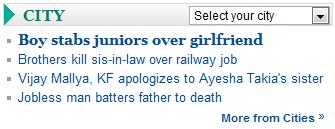
If anthropologists from 300 years later see the screenshot below, of the Times of India’s headlines right now, I wonder what conclusions they will draw:
Posted by Amit Varma on 07 November, 2008 in
India |
Journalism |
Media
Dear Times of India
In light of this post by Jyothsna of The Cooks Cottage, I’d like to inform you of a couple of things:
1. Everything on the internet is copyrighted by default. Blog posts and articles posted online cannot just be picked up and used without permission. This is especially true if your reporters put their own byline on it.
2. This applies to photos as well. (On that note, well done Twilight Fairy.)
I assume that your repeated infractions of copyright result from ignorance, not malice or apathy. Thus, it would be nice if you could educate all your staffers and editors on the points mentioned above.
And no, I am not implying that you are the only newspaper that treats the internet as a free resource. But you’re the biggest, and should lead the way by addressing this issue in your code of conduct. If you have one, that is.
Regards
Amit
*
The hall of shame: 1, 2.
More open letters here.
Posted by Amit Varma on 04 November, 2008 in
Journalism |
Media
... to Barton Hinkle, the winner of the 2008 Bastiat Prize. And also to Swaminathan Aiyar and Fraser Nelson, who came second and third respectively. Their shortlisted articles are here (pdf link). I particularly loved the first of Barton’s pieces—it’s satire that Bastiat would have been proud of.
Barton was also shortlisted last year, and his pieces then were also exceptional—you can read them here (pdf link).
Posted by Amit Varma on 30 October, 2008 in
Freedom |
Journalism |
Media |
Personal
Devangshu Datta, in a wonderful tribute to RK Laxman, comes up with a good reason to buy The Times of India:
Unfortunately, even Laxman’s presence wasn’t enough for me to continue with my daily ritual of passing the paper onto the raddi-wallah after that one brief moment of homage. For a while, I continued to take it because I was rearing kittens — it was absorbent and useful for little misunderstandings during the house-breaking phase. Once the cats became civilised, I stepped aside from that value-chain.
So if you have kittens at home, you’re excused. Otherwise, why do you read ToI?
Posted by Amit Varma on 28 October, 2008 in
India |
Journalism |
Media